
Kathryn’s Incredible Journey: From Busy Mom to Boston Marathon Qualifier
An inspiring running story from Kathryn, a dedicated homeschooling mom of four, proving that with unwavering determination and self-belief, any seemingly impossible goal is truly within reach.
Discover more inspiring running stories here and find additional motivation for your own journey. If you’re inspired to share your personal running experience or story, you can find all the details on how to contribute here.
The Genesis of a Runner: Beyond the Casual Jog
My personal journey into the exhilarating, often challenging, world of long-distance running began quite unexpectedly after the birth of my fourth child in 2010. Before this pivotal moment, running had always been a somewhat sporadic and casual activity in my life. If I managed to complete a three-mile run, it felt like a significant accomplishment, a notable achievement for someone who didn’t consider herself an athlete. The very idea of tackling a 10K race seemed like a monumental undertaking, an enormous goal that required a level of dedication I wasn’t sure I possessed. As for people who ran half marathons or full marathons? In my mind, they were nothing short of superhuman, a distinct breed of individuals endowed with extraordinary endurance and an almost mythical strength. These were feats I observed with a mix of awe and distant admiration, never imagining they could ever be part of my own reality.
Then, serendipity intervened in the form of a new friend – a running friend. She possessed an infectious enthusiasm and an unwavering belief in my untapped potential. It was she who first planted the audacious idea: “Kathryn, you could run a marathon.” My initial, almost instinctive reaction was an emphatic “NO way.” The thought felt utterly preposterous, bordering on the absurd. I was a busy homeschooling mom of four, navigating the daily chaos and joys of family life; where would I even find the time or the inherent athletic ability for such an endeavor? My self-perception was firmly rooted in being “just a mom,” not an athlete, not a runner who pursued such demanding distances.
Despite my initial skepticism, her gentle persistence eventually wore down my resistance. As a compromise, or perhaps a stepping stone, I agreed to run a half marathon in 2012. It was a challenging, yet deeply rewarding experience that subtly shifted my internal narrative. The completion of that race, while difficult, ignited a tiny spark of curiosity about what else I might be capable of. My friend, sensing this shift, continued to encourage me, pushing me gently but consistently towards the ultimate challenge. Finally, after much internal debate and a surge of courage, I made the decision: I would go for it. A full marathon. The magnitude of the commitment settled in, and the question echoed in my mind once more, this time with a mixture of excitement and trepidation: “What was I thinking? I’m a busy mom, not an athlete.” This journey, however, would soon reveal that these two identities were not mutually exclusive, but rather, could powerfully coexist and even amplify each other.
The Baptism of Fire: My First Marathon in Shiprock, NM
My inaugural full marathon experience unfolded in May 2013, amidst the vast, sun-drenched landscapes of Shiprock, New Mexico. It was, to put it mildly, an unforgiving crucible. The weather was a significant factor; the heat was relentless, beating down on the course and intensifying every single stride. It was incredibly hard, a true test of both physical endurance and mental fortitude. Physical discomfort became an unwelcome, yet constant, companion throughout the race. My IT band, in particular, screamed with pain, demanding attention with every step, making forward motion a concerted effort of will. There were moments of sheer desperation, particularly due to the multiple, inevitable bathroom stops that further punctuated the feeling of an interminable journey.
The mental battle waged within was just as intense, if not more so. “This will NEVER end,” I remember thinking, the finish line appearing as an elusive mirage, seemingly retreating with every painful step. Doubt crept in, whispering temptations to give up, to simply stop. But something deep inside, a stubborn resolve I hadn’t fully recognized before, kept me moving forward. I pushed through, driven by a determination to complete what I had started, to see this monumental challenge through to its conclusion. I stumbled across that finish line in 4 hours and 24 minutes, a chaotic mix of profound exhaustion and immense, undeniable relief washing over me. My immediate, visceral reaction, born of the raw pain and mental anguish, was a resolute declaration: “I’m NEVER doing that again.” The intensity of the experience felt like too much to ever willingly repeat.
Yet, the human spirit, especially when it comes to personal achievements and pushing boundaries, is a curious and often contradictory entity. That very same evening, despite my earlier, heartfelt vow, I found myself inexplicably drawn back to the internet. My fingers, almost autonomously, typed out searches for… another marathon. The pain, while still lingering, had already begun to recede into the background, replaced by a nascent spark of curiosity, a burning desire to understand what else I was truly capable of. The challenge had been immense, yes, but so too was the profound satisfaction of having overcome it, of proving to myself that I could endure. My eyes landed on the enticing prospect of the Utah Valley Marathon – its tagline, “Pain You Enjoy!”, seemed almost ironic, yet intriguing. Could it be true? Could I truly find a deeper satisfaction, perhaps even a form of enjoyment, in such a grueling experience, now armed with the lessons from my first attempt?
Setting a Bolder Goal: The Audacious Road to Boston Qualification
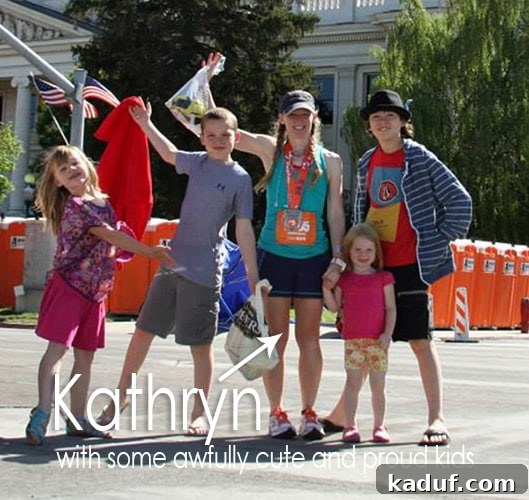
With the demanding experience of my first marathon firmly under my belt, I approached the Utah Valley Marathon with an entirely new mindset and an even more ambitious, some might say audacious, goal. This time, merely completing the distance wasn’t enough. My sights were set on something extraordinary, a dream that had once seemed utterly unattainable: qualifying for the Boston Marathon. This aspiration represented a monumental leap from my previous, more modest goals, pushing me far beyond my comfort zone. To emphasize the context, I want to reiterate that I am just a mom, much like many of you, with absolutely no formal background in competitive sports. There were no track team accolades in my past, no cross-country championships, nothing in my history that would suggest a natural propensity for elite-level running. I was simply a mom of four children, then aged between 3 and 13, attempting to achieve something truly remarkable and defy conventional expectations.
For this audacious endeavor, I committed myself to the rigorous Hanson’s training plan, known for its demanding structure and emphasis on cumulative fatigue. The initial weeks of training proceeded smoothly, building my confidence and endurance methodically, each long run and tempo workout a testament to my dedication. However, the delicate balance of preparation was dramatically disrupted during my taper phase when I was unexpectedly struck down by a nasty bout of the flu. The illness left me feeling utterly depleted and trashed, both physically and mentally, draining much of the carefully built strength. This period was further compounded by the infamous “taper insecurities” – a common and insidious phenomenon among marathoners where self-doubt creeps in as mileage decreases, making one question every aspect of their training and readiness. Despite outwardly downplaying my ambition to others, fearing the potential embarrassment of failure, my heart was resolutely, unshakeably set on achieving a Boston Qualifying (BQ) time.
I had meticulously chosen a goal pace that I believed would provide a comfortable 10-minute buffer under the BQ standard, a cushion against unforeseen challenges. Yet, as the race date loomed closer, every ounce of doubt seemed to surface, magnified by the lingering effects of the flu and the psychological toll of the taper. I began to question every training run, every meal, every strategic decision made over the preceding 18 weeks. A persistent, nagging feeling whispered that I had somehow missed a crucial element in my preparation, or that I simply wasn’t strong enough, not resilient enough, to maintain the demanding pace required for qualification. The mental fortitude needed to overcome these doubts, to silence the internal critic, became as critically important as the physical training itself. This was not just a test of my legs, but a profound examination of my will and belief in myself.
Race Day Eve: The Unpredictable Marathon of Motherhood
June 14, 2014, dawned, marking the eve of the Utah Valley Marathon – a day etched into my memory. My incredibly supportive husband and our four children embarked on a six-hour drive north from Colorado to Utah, joining me for this significant event. Their presence alone was a huge source of comfort and motivation. The evening began with the traditional pre-race spaghetti dinner, a carb-loading ritual embraced by runners worldwide, consumed with a blend of anticipation and nervous energy. After dinner, my husband, ever thoughtful and understanding of my pre-race jitters, took the kids swimming at the hotel pool. This gave me a precious window of uninterrupted time – a rare commodity for a mom of four – to meticulously prepare all my race essentials. I carefully laid out my gear, planned my nutrition, and organized my hydration strategy without any distractions. My primary goal for the evening was simple yet crucial: to get an early night’s sleep, anticipating the extremely early morning start required for the marathon.
However, as any parent knows, the best-laid plans often falter in the delightful, yet unpredictable, face of a spirited three-year-old. Once the lights were out and silence should have reigned, my youngest daughter found an unexpected, seemingly endless, burst of energy. She repeatedly got out of bed, her tiny footsteps echoing in the quiet room, her playful demands slicing through my attempts at rest. The situation quickly escalated into a desperate and panicky ordeal for me. With visions of a restless, sleep-deprived race day haunting my thoughts – a nightmare scenario for any marathoner – I fretted endlessly that I would never achieve the much-needed rest. Every minute of lost sleep felt like a minute stolen from my race performance. The irony was not lost on me: I was preparing for one of the most physically and mentally demanding challenges of my life, yet the immediate obstacle, the most formidable “opponent,” was the unpredictable energy of a toddler. It was a stark, almost humorous, reminder of the unique challenges and unexpected “marathons” faced by busy moms every single day, demands that often test endurance in ways far different from a running race.
Pre-Dawn Rituals and the Starting Line Calm
Despite the fragmented and interrupted sleep, the alarm blared at 2:30 AM, signaling the official start of my marathon day. My night had been a restless cycle of tossing and turning, my mind racing through a million race-related scenarios, constantly convinced I would oversleep despite setting three separate alarms as a fail-safe. I consciously tried to maintain a sense of calm, determined not to let the perceived lack of sleep add another layer of debilitating stress to an already high-pressure day. I told myself to stay relaxed, to trust my training, and that what was done was done; worrying wouldn’t change the past.
My pre-race ritual commenced in the quiet, pre-dawn solitude of the hotel room, a sanctuary of calm before the storm. I methodically forced down three packets of oatmeal, mixing them with hot tap water in the absence of a microwave, each spoonful a deliberate act of fueling. My iced latte, purchased the night before and kept perfectly cool in the hotel ice bucket, provided a welcome jolt of caffeine and comfort. All the while, my husband and four children remained peacefully asleep, their gentle breathing the only sound, a testament to my stealthy, practiced movements. Every item of my race gear – socks, shoes, race bib, gels, water bottle – was laid out precisely, minimizing any fumbling that might disturb the sleeping household, especially my three-year-old daughter. By 3:30 a.m., I slipped quietly out of the room, stepping into the cool, dark morning. Outside, under a sky still heavy with night, a long line of buses awaited, their engines rumbling softly, ready to transport hundreds of nervous runners to the distant starting point high in the canyon.
Dressed in old, paint-splattered sweatpants, a big, thick hoodie, and clutching a fleece blanket – an outfit chosen purely for warmth and comfort – I boarded the bus. We arrived at the starting line, high up in the canyon, around 4:30 a.m. The scene was surprisingly serene yet vibrant. Numerous campfires dotted the landscape, their flames dancing in the pre-dawn darkness, offering inviting pockets of warmth against the persistent chill of the mountain air. Although I had felt a touch self-conscious carrying such a large, seemingly cumbersome blanket, its utility quickly became abundantly clear. Fellow runners, many of whom had also brought blankets or sleeping bags, huddled together on the ground, seeking precious warmth and attempting to snatch a few more moments of rest. I even spotted one ingenious participant wrapped snugly in an old bathrobe, a truly brilliant idea! Following their lead, I rolled myself into a burrito-like cocoon on the ground, pulled my hood over my head, and just tried to doze for another hour. Lying there under the vast, star-studded sky, speckled with countless stars, a profound sense of peace enveloped me. It was a beautiful, serene moment of quiet contemplation and anticipation before the intensity of the race would begin.
All too soon, the tranquil anticipation gave way to the urgent, electrifying call to the starting line. The energy of the crowd shifted from quiet reflection to buzzing excitement. As the starting gun fired, signaling the beginning of the marathon, I performed a symbolic act, tossing my comforting blanket onto a nearby fence. It was a release, a shedding of pre-race nerves, and with a deep breath, I proceeded to cross the starting line, embarking on the next phase of my journey. This race, with its vibrant energy and a multitude of participants, felt markedly different from my first, more solitary and daunting experience in Shiprock, New Mexico. The collective excitement and palpable energy of so many runners, all sharing a common goal, was both exhilarating and profoundly motivating, carrying me forward into the unknown miles ahead.
Pacing Puzzles and Early Race Dynamics: A Garmin Gauntlet
The initial miles of the Utah Valley Marathon presented an unexpected and rather frustrating challenge with my Garmin watch. It seemed to be acting erratically from the outset, initially displaying a bewildering pace of “10-something.” I knew instinctively that I wasn’t running that slowly; my body felt much faster, suggesting a clear malfunction or an incorrect reading. Upon completing the first mile, the device finally registered a more believable 8:40 pace. While certainly faster than the previous reading, it still caused a ripple of concern and confusion; my “A-goal” pace for Boston Qualification was a precise 8:35. This slight discrepancy, combined with the earlier, nonsensical reading, introduced an unsettling element of doubt and uncertainty into my meticulously planned strategy.
The confusion deepened dramatically during the subsequent two miles when my Garmin suddenly began displaying paces consistently in the “7:xx” range. This was completely unexpected and, frankly, caused me to freak out even more. I genuinely didn’t feel like I was accelerating that much; my perceived effort didn’t match the numbers flashing on my wrist. The conflicting data – first too slow, then seemingly too fast – left me utterly disoriented and increasingly untrusting of both my device and, more disturbingly, my own perception of effort and speed. In an attempt to regain control and settle into my target pace, I consciously attempted to slow my pace as much as humanly possible, focusing intensely on deep, relaxed breathing techniques. Yet, despite my concerted efforts, the Garmin stubbornly continued to display paces resolutely in the 7s. I found myself in a bizarre mental battle, convinced I couldn’t possibly go any slower without coming to a complete stop. The actual recorded times for those miles, 7:31 and 7:35, were genuinely shocking to me, confirming the unsettling reality of my unexpected speed. This unforeseen acceleration forced me to immediately recalibrate my strategy, prioritizing a deliberate and urgent slowdown. My primary concern shifted to conserving energy and preventing the premature depletion of my precious glycogen stores. These were uncharacteristically fast paces for me, far beyond my comfortable marathon effort, and I knew that sustaining them could jeopardize my entire BQ attempt, risking a spectacular crash later in the race.
The Beauty of the Course and Mid-Race Momentum: Finding My Rhythm
Despite the initial pacing confusion and the Garmin’s puzzling readings, the first half of the marathon unfolded remarkably smoothly once I settled into a rhythm. Much of it passed in a serene blur, a testament to my focused state and the captivating surroundings; I barely recall specific details beyond the sheer enjoyment of the rolling hills and the stunning beauty of the course itself. The picturesque landscape offered a welcome visual distraction from the physical effort and provided a natural rhythm to the run. While there were sections with strong headwinds, which certainly added to the challenge, they did little to dampen my spirits. My mood remained resolutely cheerful, bolstered by the picturesque surroundings, the supportive crowd, and the overall positive energy of the race atmosphere.
The course was indeed gorgeous, living up to its promise of being predominantly downhill as indicated by the elevation profile. This downhill bias was a welcome relief for the legs over such a long distance. However, what the elevation profile didn’t fully convey were the numerous, interspersed rolling hills that peppered the route. These ascents and descents were challenging, certainly, but they also provided a crucial and welcome variation in muscle engagement, offering a brief respite for my quads from the constant, pounding impact of the downhill sections. Living at 7,200 feet in the mountains, I found a significant comfort in knowing that the elevation and terrain weren’t drastically different from what I was accustomed to in my rigorous training. This familiarity with similar geographical challenges helped me feel grounded, confident, and well-prepared to effectively navigate the course.
Upon reaching mile 13, the literal and figurative halfway point, I cued up my iPod playlist, a ritual I had eagerly anticipated. This wasn’t just any playlist; it was a carefully curated, surprise compilation created by my dear husband, who had thoughtfully asked for specific parameters to tailor it perfectly to my taste and mood. His effort and love shone through in the selection – a vibrant collection of super happy, upbeat songs that evoked a myriad of powerful emotions. They made me laugh out loud with their nostalgic charm, featuring corny but beloved tunes from my childhood like the catchy theme from “Happy Days” and the unforgettable jingle from “Laverne & Shirley.” These joyful melodies lifted my spirits, bringing tears of happiness and pure exhilaration, a perfect emotional boost. It was the ideal auditory fuel, a truly touching gesture that not only underscored the incredible support system I had but also injected a much-needed surge of positive energy to carry me through the challenging second half of the race.
The Mile Markers of Struggle: Stomach Issues and IT Band Pain Emerge
For a significant and encouraging portion of the race, my meticulously planned fueling and hydration strategy seemed perfectly on track, and I felt exceptionally strong, a sensation that fueled my confidence. This sense of well-being, however, persisted only until I hit mile 16, where an all-too-familiar and unwelcome nemesis reappeared with a vengeance: stomach issues. Despite proactively taking Imodium before the race – a necessary precaution born from the challenging and uncomfortable experience of my first marathon a year prior, which had been punctuated by frequent pit stops due to similar gastrointestinal problems – my stomach began to rebel once more. Thankfully, almost miraculously, a porta-potty materialized at precisely the opportune moment, allowing for a quick, albeit frustrating and momentum-breaking, stop. The immediate consequence was a noticeable and disheartening slowdown in miles 16 and 17, and the loss of those precious minutes felt like a significant setback to my BQ aspirations.
The internal battle intensified around mile 20. The urgency to find another porta-potty became absolutely paramount; a “really quick” stop was an understatement, as the alternative would have been deeply embarrassing and potentially race-ending. Mercifully, I found myself right at another one, and to my immense relief, there were no lines. But again, more time, crucial time, slipped away. At this critical juncture, another persistent issue from my first marathon, my IT band, also began to make its presence aggressively felt. It was as if a cascade of physical challenges was conspiring against me, each one threatening to derail my progress. The sharp, persistent pain in my IT band continued relentlessly, a constant, nagging reminder of the brutal toll the distance was taking on my body, and it continued to bother me all the way to the finish line, turning every step into a test of pain tolerance.
By mile 21, the thought of consuming another Gu packet, with its sickly sweet, artificial taste, was utterly repellent. My palate screamed for something different, something real. In a moment of sheer desperation and craving, I spotted and grabbed a banana from a volunteer. I held it firmly, then, without a moment’s hesitation or concern for appearances, smashed it in my hand and ate it with a primal intensity, much like I would a Gu, the sticky fruit smearing down my arm and leg. I was a complete mess – sticky, disheveled, and utterly focused – but at that point, honestly, I didn’t care in the slightest. My focus had narrowed to one singular, overriding objective: moving forward, beyond any concern for appearance, decorum, or minor discomforts. It was about survival and relentless progress.
The Home Stretch: Encouragement, Doubt, and Unyielding Determination
Mile 22 brought a much-needed, incredibly powerful surge of emotional energy that temporarily eclipsed the physical agony. My husband and our four children were there, their cheers resounding, a vibrant beacon of love and unwavering support amidst the profound physical and mental fatigue that was setting in. My husband, ever the encourager, even ran alongside me for a short stretch, offering words of encouragement that, though I couldn’t articulate a reply due to sheer exhaustion, resonated deeply within my core. Their collective presence was a powerful, visceral reminder of why I was enduring this immense challenge, reigniting a flicker of resolve when it felt like it was about to extinguish.
As I entered the final, brutal stretch, the miles – 24, 25, and 26 – blurred into an agonizing continuum. A profound, almost desperate question began to echo relentlessly in my mind: would this race ever truly be over? I had poured every ounce of my being, every reserve of energy, into the effort, leading to a frightening thought – had I pushed too hard? Could I collapse before the finish line, my body giving out before my will? It felt as though the wheels were not just falling off, but had already detached and rolled away, leaving me sputtering towards the end. During these brutal final five miles, my mind, despite its fatigue, desperately tried to perform complex mental arithmetic, attempting to calculate if a Boston Qualification (BQ) was still within reach. In my utterly fatigued and disoriented state, the numbers seemed to conspire against me; I repeatedly concluded that it was simply too close, that I had squandered too much time, plunging me into deep despair. (My calculations, as I later realized after the fact, were utterly incorrect due to my inability to concentrate clearly under such immense pressure.)
Despite the overwhelming doubt and the escalating physical agony, an unwavering inner voice, a deep wellspring of resilience, urged me on. I told myself to “dig deep,” to “leave it all on the course,” to give absolutely everything I had left. The powerful mantra, “If it was easy, everyone would be doing it,” became a potent internal motivator, a sharp reminder of the unique challenge and reward I was pursuing. I tried, with every fiber of my being, to talk myself into believing I was strong, even when every muscle, every joint, every nerve screamed otherwise. The last three miles, though run at a pace slightly below my initial goal, were completed with every last shred of energy I possessed. It was a testament to sheer willpower, an unwavering refusal to surrender to the pain or the doubt, a final, unyielding push towards the finish line, no matter the cost.
The Triumphant Finish: A Flood of Overwhelming Emotion
Finally, after what felt like an eternity, I crossed the finish line at an astonishing 3 hours, 45 minutes, and 23 seconds – a full 9 minutes and 37 seconds under the Boston Qualification time! The very moment I passed the timing mat, an uncontrollable, tidal wave of emotion swept over me. Tears, not of defeat but of an overwhelming, profound culmination of every challenge, every doubt, every grueling stride, burst forth from deep within. Deep, racking sobs erupted from my inner being, a visceral release of nearly a year of dedicated effort, immense physical pain, and relentless mental pressure. I instinctively sought out my husband, spotting him in the crowd, and literally fell into his waiting arms, where I continued to sob uncontrollably, burying my face in his shoulder.
He, understandably, initially believed my tears were those of profound disappointment, thinking I hadn’t qualified. When I managed, through my raw sobs and gasps for air, to convey the incredible news that I *had* qualified – and by such a significant margin of over 9 minutes – the joy, relief, and sheer elation that followed were palpable, almost intoxicating. It was a crying spell born from the sheer magnitude of the accomplishment, the unexpected triumph against overwhelming self-doubt, and the incredible, transformative journey that had brought me to that exact, unforgettable moment. It was the culmination of absolutely everything – the sleepless nights, the grueling training runs, the stomach issues, the IT band pain, the mental battles, and the unwavering, silent support of my incredible family.
After that intensely emotional release, the celebration began in earnest. I had the immense pleasure and honor of ringing the PR bell, a joyful tradition for those achieving personal bests, and received my coveted BQ shirt – a special garment proudly awarded by the race organizers to those who successfully qualify for the Boston Marathon. We then headed back to the hotel, where I sank into the blissful, soothing warmth of the hot tub while the kids splashed happily and noisily in the pool, their joy reflecting my own quiet triumph. My thoughtful family had even purchased a decadent chocolate éclair for me, a sweet reward. Though I felt too nauseous from the exertion to eat it immediately, about an hour later, I finally savored every glorious bite. It was the perfect, well-deserved sweet ending to an intensely hard-fought victory.
Looking Forward: Boston Bound and Beyond
Seven months have passed since that incredible, life-altering day at the Utah Valley Marathon. Now, in January 2015, I find myself deeply immersed in training once again, preparing for my third marathon. But this time, the destination is truly special, almost surreal: I am going to Boston. The phrase “Never say never” has become a powerful, living mantra in my life, a testament to how far I’ve come. I honestly, genuinely never believed that participating in the iconic Boston Marathon would ever be a possibility for me. I always saw myself as just a normal person, a simple stay-at-home mommy whose athletic endeavors, if they existed at all, were secondary to her primary family responsibilities and daily routines.
Yet, my journey from a casual runner to a Boston Marathon qualifier has unequivocally proven a profound truth: if you set your mind to something, if you commit to a goal with unwavering dedication, and pursue it with relentless determination, anything is truly within your grasp. My story is not one of a born athlete, nor is it about exceptional talent. Rather, it is the story of an ordinary individual who chose to chase an extraordinary dream, who dared to believe in her own potential despite all external and internal doubts. And in doing so, I discovered a strength, a resilience, and a capacity for perseverance I never knew I possessed. It’s a powerful testament to the transformative power of belief, the indomitable spirit of perseverance, and the incredible human capacity to achieve what once seemed utterly impossible, defying all expectations, including your own. It’s about finding the athlete within, regardless of your starting point.
So, to everyone reading this, especially those who might feel like they are “just” a mom, “just” a regular person, or “just” someone with everyday responsibilities: you can do it. Whatever “it” is for you – whether it’s running a 5K, starting a new hobby, pursuing a career goal, or simply finding more time for yourself – set your mind to it, embrace the challenges that will inevitably arise, and most importantly, believe in your own unique ability to achieve it. Your biggest advocate is yourself.
With unwavering encouragement and shared spirit,
Kathryn