
The Great Cookie Experiment: Does Chilling Dough Make Better Chocolate Chip Cookies?
Welcome back to The Great Cookie Experiment, where we meticulously dissect the science and art of baking to uncover the secrets behind truly exceptional cookies. Following our revelatory first installment on butter temperature (a topic so impactful it’s often described as life-changing!), we’re now tackling another highly debated and swirling issue in the realm of chocolate chip cookie perfection: the practice of chilling cookie dough prior to baking.
For years, home bakers and culinary experts alike have pondered the necessity and benefits of refrigerating cookie dough. Influential recipes, like the renowned New York Times chocolate chip cookie, have championed this method, advocating for dough to be chilled for 24, 36, or even 48 hours. Proponents claim that this extended rest period significantly develops flavor and enhances texture, transforming a good cookie into an extraordinary one. The sheer volume of questions from many of you in the comments of our previous post solidified this topic’s place at the top of our experiment list.
Unveiling the Chilling Mystery: Our Experimental Approach
So, when embarking on another crucial phase of The Great Cookie Experiment, what’s a dedicated baker to do? Simple: chill some dough! Our mission today is to thoroughly investigate whether the hype surrounding chilled cookie dough holds up, comparing immediate baking against various chilling durations to determine the real impact on your chocolate chip cookies.
The Foundation: Our Classic Cookie Dough Recipe
To maintain consistency and ensure accurate comparison, we utilized the same basic chocolate chip cookie dough recipe that served as our control in the butter temperature experiment. This is a timeless, straightforward recipe that calls for room temperature butter. For the purposes of today’s chilling investigation, I meticulously ensured that the butter was at a perfectly cool room temperature, avoiding any variables that might skew the results and focusing solely on the chilling variable.
Setting Up the Experiment: Three Distinct Groups
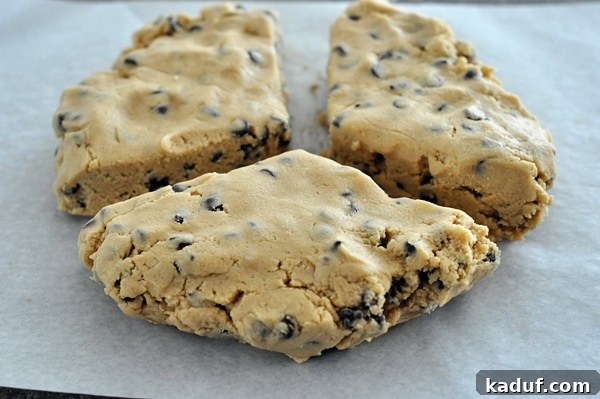
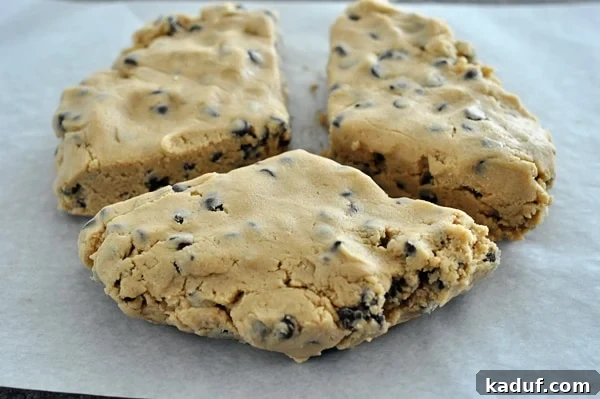
With our consistent dough base prepared, I carefully divided it into three distinct sections, each destined for a different fate:
- Group 1: Baked Immediately. One generous portion of cookie dough was prepared for baking without any refrigeration, representing the spontaneous joy of immediate gratification.
- Group 2: Refrigerated for 24 Hours. The second section was lovingly wrapped and placed in the refrigerator for a full day, aligning with many popular chilling recommendations and offering a significant rest period.
- Group 3: Refrigerated for 48 Hours. The final segment endured an extended chill of 48 hours. While some recipes suggest 36 hours, practicalities dictated a 48-hour test (because a 3 a.m. baking session was simply not going to happen!).
To ensure a fair comparison, each cookie, regardless of its chilling journey, was portioned at approximately 1.5 tablespoons of dough and baked for the same precise amount of time (11 minutes in my oven). This rigorous control allows us to isolate the impact of chilling time on the final product, from spread to internal texture and flavor. Below, you can see the three prepared dough portions, awaiting their destiny.
The Results Are In: A Cookie-by-Cookie Breakdown
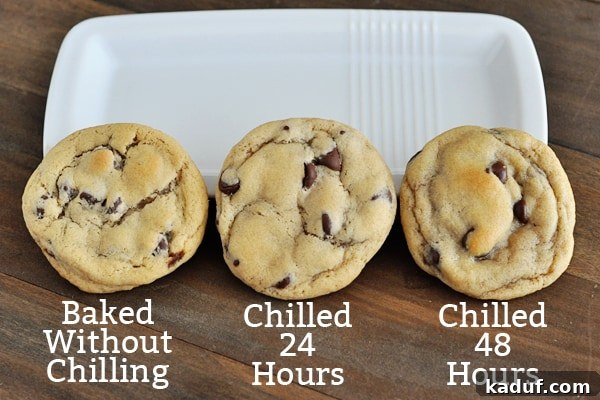
After their journey from dough to deliciousness, here’s a lineup of our baked contenders. Visually, they are all quite appealing, showcasing the inherent beauty of a classic chocolate chip cookie. But as we know, true beauty is more than skin deep – especially when it comes to cookies! Let’s delve deeper into the unique characteristics and surprising revelations of each batch, examining their appearance, texture, and taste.
The “No Chill” Cookie: Instant Gratification
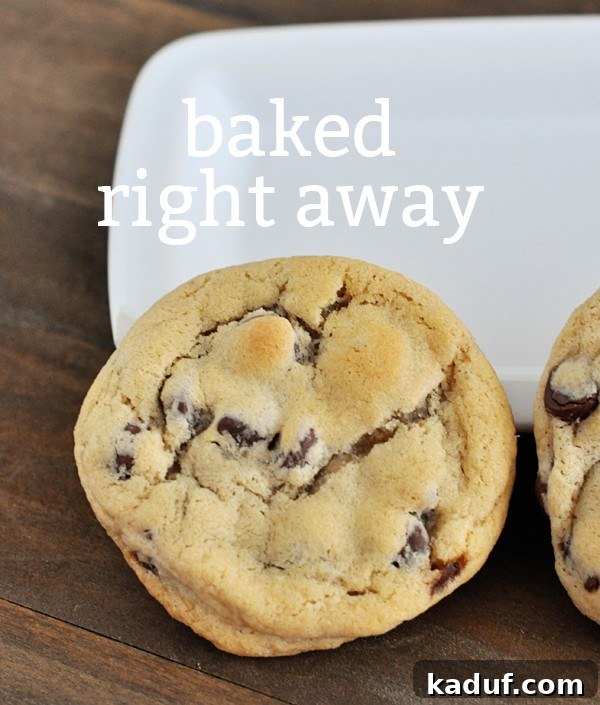
This delightful cookie was baked immediately after mixing the dough, offering the quickest path to a warm treat. As anticipated, it delivered everything one expects from a freshly baked, unchilled cookie. It was wonderfully soft and chewy, maintaining its shape perfectly throughout the baking process without excessive spreading. This is the quintessential chocolate chip cookie I’ve enjoyed countless times over the years, precisely because I rarely make plans hours or days in advance for my cookie cravings. When the mood strikes for cookies, I want cookies right then! Its texture was consistently satisfying, embodying that perfect balance between a soft interior and slightly crisp edges, albeit with a subtle hint of a cake-like crumb compared to its chilled counterparts. This cookie is a testament to the fact that you don’t always need to wait for delicious results.
The 24-Hour Chilled Cookie: Enhanced Buttery Notes and Convenience
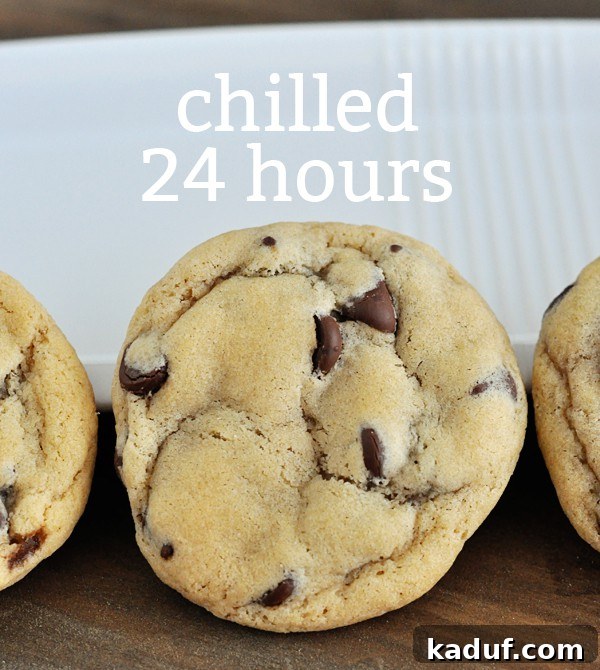
Next up is the beauty that spent a full 24 hours chilling in the refrigerator before meeting the oven’s heat. Interestingly, despite being baked for the exact same duration as the other cookies, this one didn’t brown quite as deeply, maintaining a slightly paler, yet still golden, hue. However, its texture was remarkably soft and noticeably less cakey. While the “no chill” cookie exhibited a slight cakey quality, this 24-hour chilled cookie offered a distinctly more buttery tasting experience. The flavors seemed to have mellowed and deepened during the refrigeration, creating a richer, more complex profile that truly highlighted the butter’s contribution.
A significant observation concerning the dough itself was its stiffness. Due to the chilling, it was impossible to scoop out the dough with a standard cookie scoop – a minor setback for someone who cherishes their scoop like a beloved family member! I resorted to digging the stiff dough out of the bowl, estimating portions by eye, and rolling them by hand between my palms. This made achieving perfectly round cookies a bit more challenging before baking, adding an extra step to the preparation process.
However, the convenience factor cannot be overstated. Waking up in the morning to ready-to-bake cookie dough in the fridge (not for breakfast, of course… mostly!) meant warm, freshly baked cookies could be enjoyed before 9 a.m. This readiness offers a wonderful advantage for busy mornings, planned treats, or unexpected guests. (Okay, maybe a few *were* sampled for breakfast, purely for scientific purposes, naturally. Who could resist?) This aspect of make-ahead baking is a strong point in favor of chilling.
The 48-Hour Chilled Cookie: A Puzzling Outcome
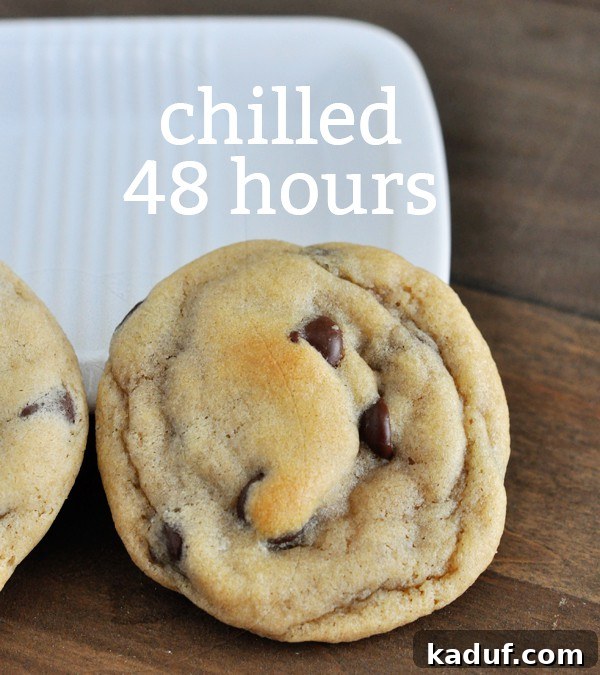
Finally, we arrive at the cookie from the dough that was chilled for a full 48 hours. The handling of the dough mirrored the 24-hour batch: stiff, difficult to scoop, and requiring manual rolling into balls. While the convenience of having pre-made dough was still present, the baked result was perplexing. Despite being baked for the identical amount of time as the others, and even exhibiting lovely golden notes on its exterior, the cookie itself remained distinctly doughy and almost greasy. Even adding an extra minute to the baking time for subsequent cookies in this batch yielded the same unsatisfactory result. This outcome left me genuinely confused and befuddled, questioning the benefits of such an extended chilling period for this particular recipe. It seems that for this specific dough, 48 hours might be past its prime, leading to an undesirable texture rather than an enhanced one.
Flavor and Texture Analysis: A Side-by-Side Comparison
When it came to evaluating texture and flavor, I must be completely honest – and I’ll openly admit that my palate isn’t necessarily refined to detect the most subtle nuances. Surprisingly, I didn’t observe a huge, transformative difference in flavor across the batches that would justify an extended wait for every single batch of cookies. The 24-hour chilled cookie certainly stood out for its more pronounced buttery taste – a rich, delicious buttery flavor, distinctly not greasy – but beyond that, there wasn’t a groundbreaking distinction that would make one definitively superior in flavor.
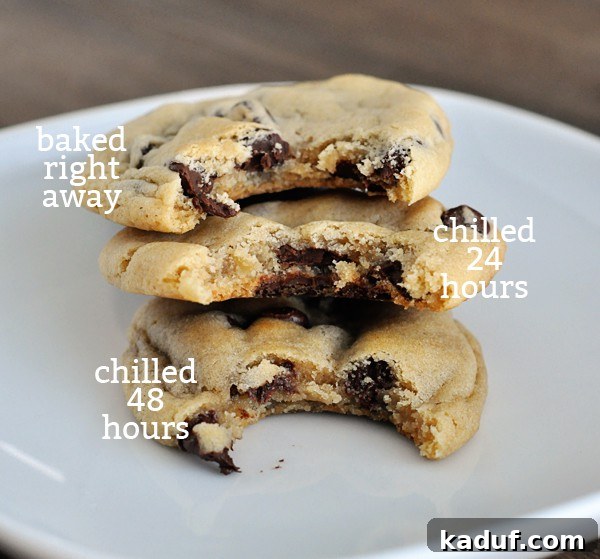
From the visual perspective, as seen in the photograph below, all three cookies appear quite similar in their overall structure and spread. However, upon closer inspection and, more importantly, through rigorous taste-testing, the differences in texture became apparent. The cookie baked instantly, as noted earlier, possessed a slightly cakier texture. This subtle difference might have gone unnoticed had I not tasted it side-by-side with the other cookies (a truly arduous task, I assure you!). It was indeed cakier and less distinctly buttery compared to its chilled counterparts. The 48-hour cookie, unfortunately, was too soft and greasy for my personal preference, failing to achieve that coveted balance of chewiness and crispness. It felt as though the fats had separated or the flour had over-hydrated, leading to a less appealing mouthfeel.
Of course, my rigorous scientific methodology demanded that I sample a bite from *each* cookie in every batch, *just to be absolutely sure*. A scientist’s dedication knows no bounds, especially when delicious chocolate chip cookies are involved!
The Verdict: Is Chilling Cookie Dough Worth It?
After this extensive exploration into the world of chilled cookie dough, it’s time for the definitive conclusion. This is weighty and important, so hold onto your mixing bowls!
For me, personally, chilling the dough didn’t entirely convince me that it’s a mandatory step for every single batch of cookies I make. The thousands of cookies I’ve baked over the years, without bothering with a chill, have been undeniably delicious. In the grand scheme of things, and for *this specific recipe*, I simply didn’t notice a remarkable or game-changing difference in taste and texture solely attributable to the chilling process that would warrant a mandatory wait.
Here’s the real kicker for my baking habits: I very rarely plan ahead 24 or 48 hours for cookies. Chocolate chip cookies in my home are a spontaneous delight, a simple pleasure, and often a spur-of-the-moment venture. In this household, no one is patiently waiting for two days for a warm cookie! Therefore, from a practical standpoint, making chilling a routine step for every batch would be a tough sell for me. The immediate satisfaction of a freshly baked cookie often outweighs the subtle improvements offered by chilling.
However, the convenience of having chilled cookie dough ready-to-be-baked truly cannot be understated. For planned events, busy mornings, or when you know you’ll want fresh cookies on demand, the make-ahead aspect of chilling is an absolutely fantastic idea. It transforms spontaneous baking into effortless baking, providing warm cookies with minimal fuss when the time is right. This advantage, especially for the 24-hour chill, is significant and can be a game-changer for entertaining or streamlining your baking process.
Considering the unsatisfactory outcome of the 48-hour chilled cookie, my recommendation, if you choose to chill, is to limit the refrigeration period to a maximum of 24 hours. This period seemed to yield the best balance of enhanced flavor (the buttery notes) and acceptable texture without crossing into the “greasy and doughy” territory. If you’re baking chocolate chip cookies for a special event, to impress discerning guests, or for someone possessing the most refined palate in the universe, then by all means, consider chilling the dough for a day. Otherwise, for everyday cookie cravings, you might find equal joy in baking immediately. As an alternative for make-ahead convenience without the full chill, you can always roll the dough into balls and freeze them, similar to this method and gift idea, which offers flexibility without commitment to immediate baking.
Important Considerations and Rebellious Baking Notes
It’s crucial to add a few disclaimers and expand on the context of these findings, as baking is rarely a one-size-fits-all endeavor:
- Recipe Specificity: This entire chilling experiment and its conclusions apply specifically to the basic cookie dough recipe I used. Cookie recipes vary wildly in their fat, sugar, and flour ratios, and these differences can dramatically alter how dough reacts to chilling. A recipe with a higher fat content, for example, might benefit more from chilling to prevent excessive spread, while a drier dough might not need it at all.
- When Chilling is Essential: For other recipes that explicitly state or strongly recommend chilling the dough – especially if it’s meant to prevent excessive spreading, flat cookies, or to help complex flavors meld – you should absolutely heed those instructions. Chilling can solidify butter, preventing it from melting too quickly in the oven and helping cookies maintain their structure, a critical factor for certain doughs.
- A Touch of Rebellion: I confess, I am a bit rebellious in the kitchen! There have been instances where a recipe called for chilling, and I’ve proceeded to bake the cookies right away, often with perfectly acceptable results. (No judgment, please!). This highlights the importance of understanding your ingredients and trusting your instincts.
- Chilling Success Stories: Conversely, I have also strictly followed chilling instructions for specific recipes, such as a recent batch of Salted Peanut Butter Cup Dark Chocolate Cookies, and the results were phenomenal. Would they have been equally great without the chill? It’s hard to say definitively without a side-by-side test, which I didn’t have time for then. My ultimate encouragement is to use your best judgment, get to know your recipes, and experiment in your own kitchen to discover what works best for you and your palate.
- Short Chills vs. No Chill: For this experiment, I also tested a portion of dough chilled for just an hour or two. I opted not to include it in the main results section because, frankly, those cookies were virtually identical to the “baked immediately” batch in both flavor and texture. So, if you’re hoping for a quick chilling hack, it seems a very short chill might not make a significant difference with this particular recipe.
And with that, our deep dive into cookie dough chilling concludes! This experiment reinforces that while chilling can offer benefits like convenience and subtle flavor enhancement for some recipes, it’s not a universal mandate for achieving delicious results with every cookie dough. Understanding the “why” and “how” of baking allows us to make informed choices that best suit our ingredients, recipes, and personal baking preferences.
Stay tuned for the next thrilling installment of The Great Cookie Experiment! We’ll likely be exploring other fascinating variables, perhaps diving into the impact of different baking pans and various pan lining materials, or even the role of different types of flour. Exciting stuff, isn’t it? The quest for the perfect cookie continues!