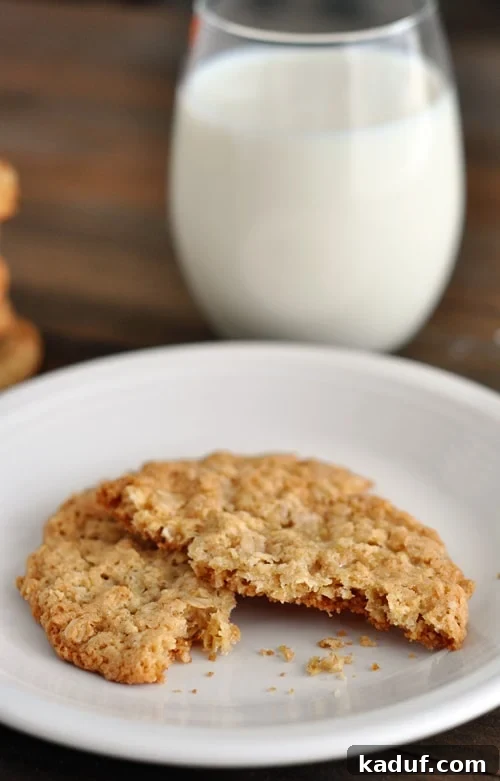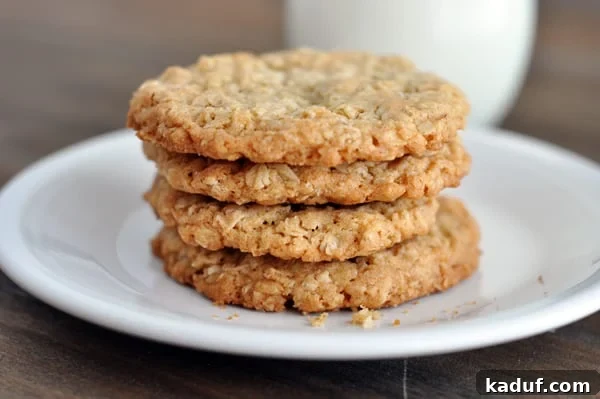
Irresistibly Thin and Crispy Oatmeal Cookies: Your New Favorite Recipe!
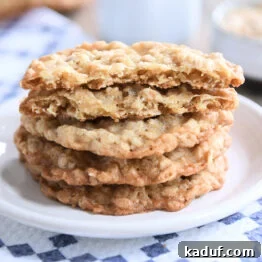
These thin and crispy oatmeal cookies aren’t just a treat; they’re an experience. Perfectly buttery, wonderfully delicate, and utterly addictive – we challenge you to stop at just one!
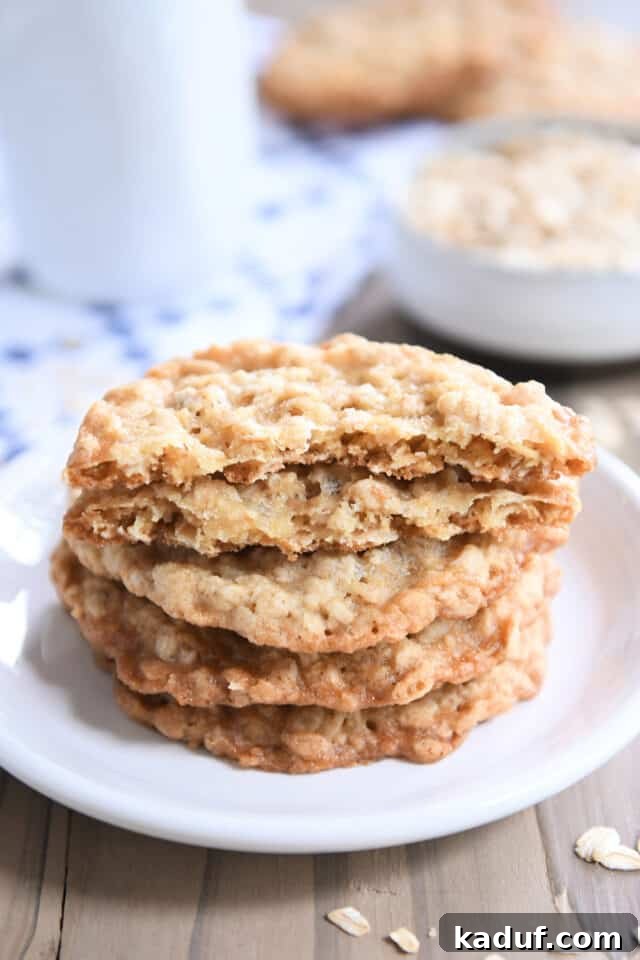
While I often find myself drawn to the comforting embrace of a soft and chewy cookie, there’s an undeniable allure to these thin and crispy oatmeal cookies that sets them apart. They offer a delightful contrast, a crisp exterior giving way to a rich, buttery interior that simply melts in your mouth.
This classic recipe transforms simple ingredients into something truly extraordinary, embodying the perfect balance of texture and flavor that has captivated cookie lovers for generations. If you’re searching for that ideal crunchy oatmeal cookie, your quest ends here.
Unlocking the Secret to Perfectly Crispy Oatmeal Cookies
Crafting a truly thin and crispy oatmeal cookie isn’t a mystery; it’s a science. The cookie dough itself is remarkably straightforward, requiring no complex techniques or exotic ingredients. However, the magic lies in understanding a few fundamental principles that differentiate a chewy cookie from a gloriously crisp one.
The delightful thinness and incredible crispness of these oatmeal cookies are achieved through a careful balance of ingredients and baking techniques. Here are the critical factors that contribute to their irresistible texture:
- Higher Butter to Flour (and Eggs) Ratio: An increased amount of butter relative to flour and eggs plays a pivotal role. More fat means more spread in the oven, leading to thinner cookies. As the moisture evaporates from the thinner cookie, the higher fat content helps create that coveted crisp texture, as the butter contributes to a tender crumb while promoting browning and a satisfying crunch.
- More Granulated Sugar, Less Brown Sugar: The type of sugar used is a game-changer. Granulated sugar, being a dry sugar, promotes crispness by allowing the cookies to spread more readily and dry out as they bake. Brown sugar, on the other hand, contains molasses, which adds moisture and acidity, resulting in a softer, chewier texture. By prioritizing granulated sugar, we ensure a cookie that snaps rather than bends.
- Old-Fashioned Rolled Oats, Not Quick Oats: This might seem like a minor detail, but the type of oats is crucial. Old-fashioned rolled oats are thicker and retain their shape better during baking, providing a substantial texture that enhances the cookie’s structure without making it dense. Quick oats, being more finely processed, absorb liquids faster and can lead to a puffier, less crispy cookie.
- Slightly Longer Baking Time (Don’t Underbake!): Proper baking duration is essential for achieving crispness. Baking the cookies for a slightly longer period, typically until golden brown, allows more moisture to evaporate. This drying process is what truly sets the crisp texture. Underbaking, even by a minute or two, can leave too much moisture, resulting in a softer cookie.
The dough itself is versatile and can be efficiently mixed using either a stand mixer or a handheld electric mixer. The key to maintaining the perfect texture, however, is to exercise caution and **avoid overmixing the dough once the dry ingredients have been added.** Overmixing develops gluten in the flour, which can lead to a tougher, chewier cookie – the opposite of what we’re aiming for here.
The Oatmeal Debate: Old-fashioned vs. Quick Oats
When it comes to achieving the distinct thin and crispy texture of these oatmeal cookies, the type of oats you choose is paramount. This recipe specifically calls for old-fashioned rolled oats, and for good reason.
Old-fashioned rolled oats are whole oat groats that have been steamed and then rolled into flat flakes. This process makes them thicker and larger than quick oats, allowing them to absorb moisture slowly and retain some of their structure even after baking. In our crispy cookie recipe, they contribute to a desirable chewiness in the centers and help maintain the cookie’s spread without becoming mushy.
Quick oats, on the other hand, are processed more extensively. They are pre-cooked, dried, and then rolled into thinner, smaller flakes. While convenient for a quick breakfast, their fine texture and high absorbency mean they will soak up liquids much faster in cookie dough. Substituting quick oats in this recipe will almost certainly result in cookies that are thicker, puffier, and lack the delicate crispness we’re aiming for. They tend to create a more cake-like or dense texture rather than a spread-out, crunchy one.
It’s also important to note that steel-cut oats (also known as Irish or Scottish oats) are entirely unsuitable for this recipe. These are simply oat groats cut into two or three pieces, not rolled. They require significantly more liquid and cooking time and would remain hard and unpleasantly chewy in a cookie batter.
Therefore, for the absolute best outcome – cookies that are perfectly thin, crisp, and wonderfully buttery – it is essential to stick to old-fashioned rolled oats. Don’t compromise on this ingredient; it truly makes all the difference!
A Beloved Classic: Over a Thousand 5-Star Reviews Can’t Be Wrong!
There’s a reason this particular recipe for thin and crispy oatmeal cookies has garnered such widespread adoration and more than 1,000 five-star reviews. It’s not just a recipe; it’s a culinary staple that consistently delivers joy with every bite. The combination of rich butteriness and delicate crispness creates a cookie that is universally loved.
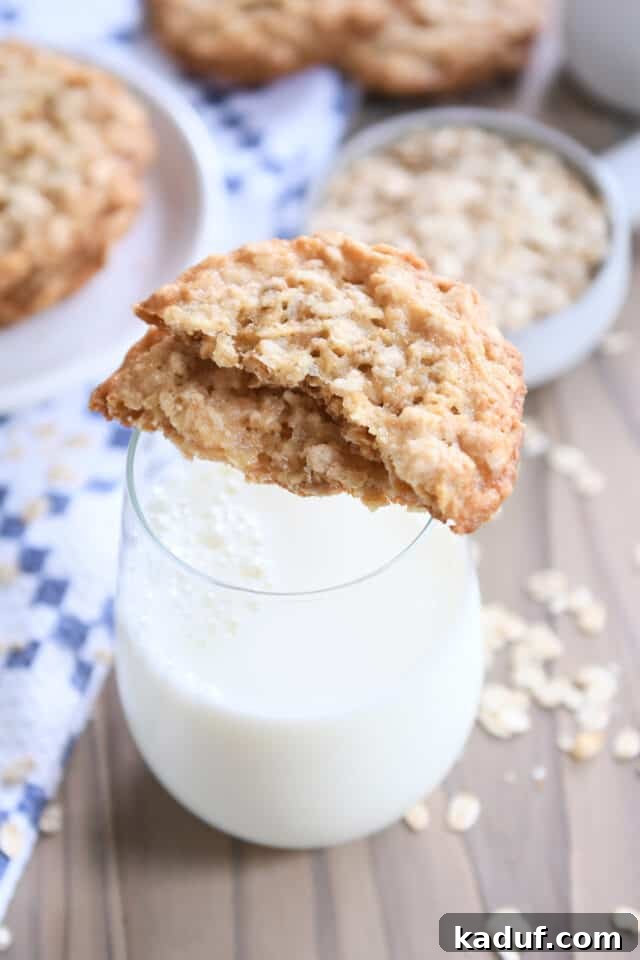
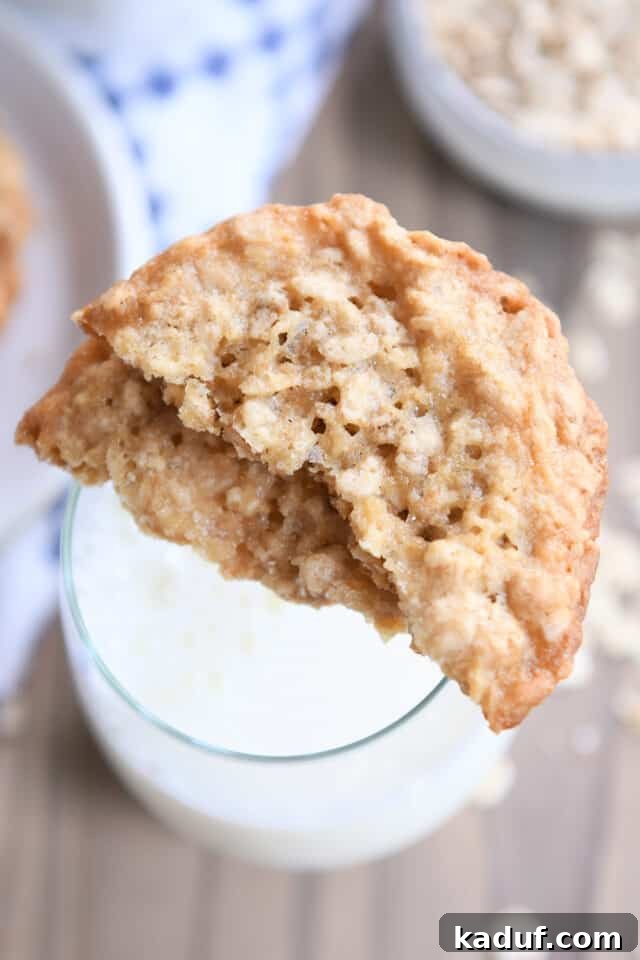
It goes without saying that these delightful oatmeal cookies reach peak perfection when paired with a tall, frosty glass of cold milk. The cool creaminess of the milk perfectly complements the cookie’s crisp texture and sweet, oat-filled flavor. It’s a simple pleasure that transports you back to childhood and creates new cherished memories.
Don’t just take our word for it; hear what others are saying about these irresistible treats:
Grace says: “This is my all-time favorite recipe I’ve used for years. After trying this, you won’t be able to go back to any other oatmeal cookie recipe, and all other oatmeal cookies will taste inferior. Pure perfection!” ⭐️⭐️⭐️⭐️⭐️
MM says: “Amazing cookies! I’m afraid to make them again because I ate 18 cookies in 4 days. They’d be good with chocolate chips in them too. Maybe I’ll try it when I get better at sharing…” ⭐️⭐️⭐️⭐️⭐️
Sara says: “OK. I didn’t think these would be as good as they are. I’ve had oodles and oodles of oatmeal cookies, and these are now our favorite. Truly outstanding!” ⭐️⭐️⭐️⭐️⭐️
Linda says: “These are wonderful… Buttery, chewy, and crisp. I’m eating them with a glass of cold milk. I baked them 16 min, and they came out perfectly.” ⭐️⭐️⭐️⭐️⭐️
Frequently Asked Questions About Thin and Crispy Oatmeal Cookies
Absolutely! This cookie dough freezes beautifully. Simply scoop the dough into balls, place them on a parchment-lined baking sheet, and freeze until solid. Once frozen, transfer the dough balls to an airtight freezer bag or container. When you’re ready to bake, you can bake them directly from frozen, adding a minute or two to the baking time. This is a fantastic way to always have fresh, warm cookies on hand!
For this particular recipe, I consistently use salted butter. The slight saltiness it provides beautifully balances the sweetness of the cookies, enhancing their overall flavor profile. If you only have unsalted butter on hand, you can certainly use it, but I recommend adding an extra ¼ teaspoon of salt to the dry ingredients to achieve a similar depth of flavor.
To maintain their crispness, store these oatmeal cookies in an airtight container at room temperature. If you find they start to lose some of their crispness over time (which can happen, especially in humid environments), you can try storing them uncovered for a day or two, or even briefly re-crisping them in a low oven (around 250°F / 120°C) for 5-7 minutes. Make sure they are completely cooled before storing to prevent condensation.
No, for the best results and to achieve the signature thin and crispy texture, you absolutely must use old-fashioned rolled oats. Quick oats are processed differently and will result in a puffier, softer cookie that doesn’t spread as much. Steel-cut oats are also not suitable as they won’t soften adequately during the baking process and will lead to an undesirable hard texture. Stick to old-fashioned rolled oats for success!
Thin and Crispy Oatmeal Cookies
24
cookies
20
16
36
Pin
Rate
Save
Ingredients
-
1
cup
(142 g)
all-purpose flour -
¾
teaspoon
baking powder -
½
teaspoon
baking soda -
½
teaspoon
salt -
14
tablespoons
(198 g)
butter (I use salted),
softened but still slightly cool -
1
cup
(212 g)
granulated sugar -
¼
cup
(53 g)
packed light brown sugar -
1
large egg -
1
teaspoon
vanilla extract -
2 ½
cups
(250 g)
old-fashioned rolled oats
Instructions
-
Adjust an oven rack to the middle position and preheat your oven to 350°F (175°C). Line large, rimmed baking sheets with parchment paper; this will prevent sticking and aid in easy cleanup. Set the prepared baking sheets aside.
-
In a medium bowl, thoroughly whisk together the all-purpose flour, baking powder, baking soda, and salt. Ensure these dry ingredients are well combined to allow for even leavening and flavor distribution in your cookies.
-
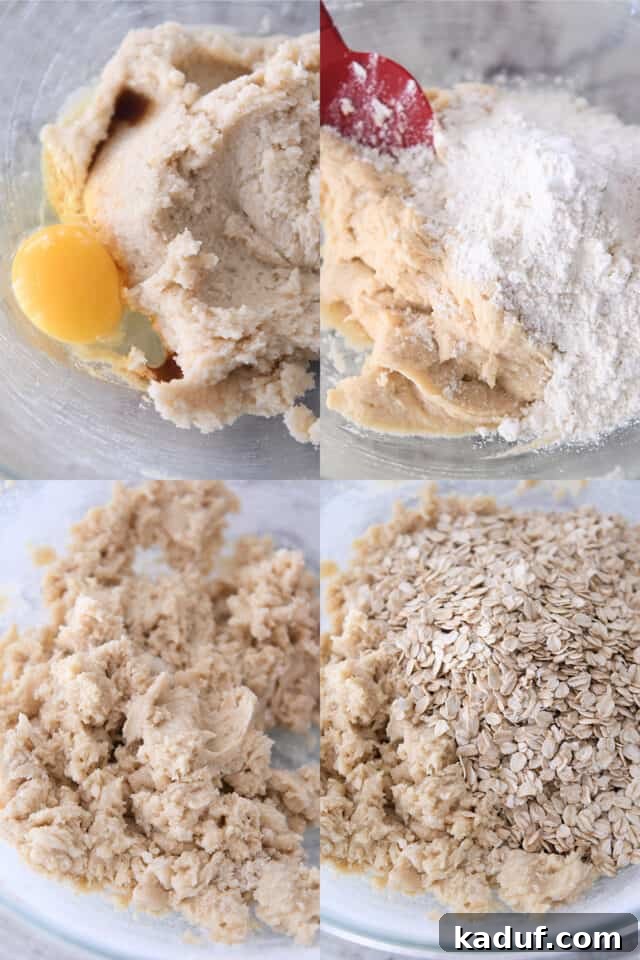
In a large bowl (preferably of a stand mixer fitted with the paddle attachment, or with a handheld electric mixer), beat the softened (but still slightly cool) butter, granulated sugar, and light brown sugar together. Mix on low speed until just combined, which should take about 20 seconds. Increase the mixer speed to medium and continue beating until the mixture becomes light and fluffy, usually about 1 minute longer. Periodically scrape down the sides of the bowl with a rubber spatula to ensure all ingredients are incorporated evenly.
-
Add the large egg and vanilla extract to the butter and sugar mixture. Beat on medium-low speed until these wet ingredients are fully mixed into the dough, approximately 30 seconds. Scrape down the sides of the bowl once more. Next, add the whisked dry flour mixture to the wet ingredients. Mix on low speed until the flour is barely incorporated, typically 10-20 seconds. It’s perfectly fine if there are still a few small pockets of dry flour at this stage; overmixing at this point can lead to tough cookies.
-
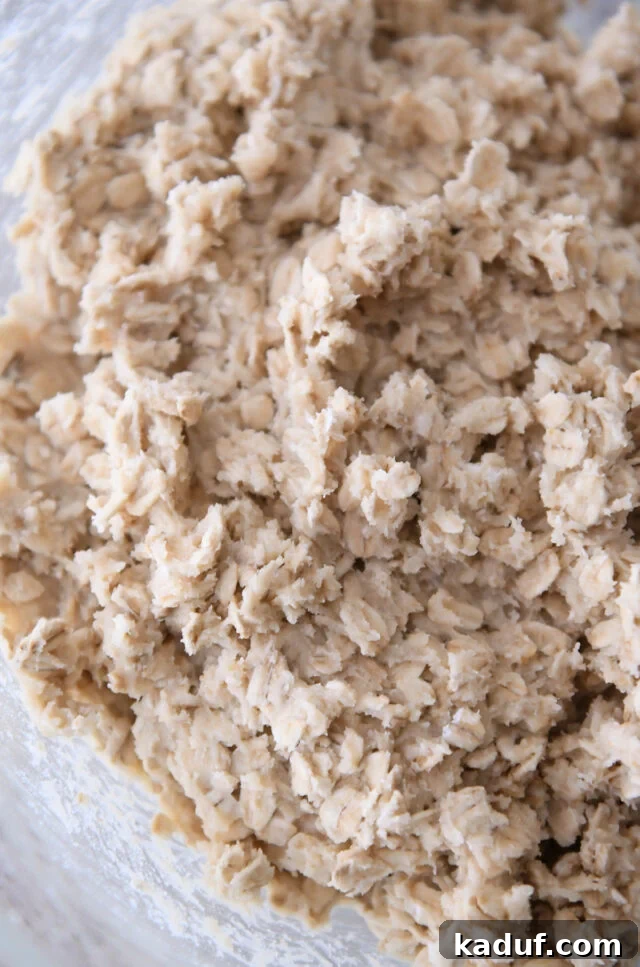
Gradually add the old-fashioned rolled oats to the dough. Mix on low speed until the oats are evenly distributed and well-combined throughout the dough, which should take about 30 seconds to 1 minute. If necessary, give the dough a final stir by hand with a sturdy wooden spoon to ensure no hidden flour pockets remain and all ingredients are thoroughly incorporated.
-
Scoop out approximately 2-tablespoon sized mounds of dough. Roll these mounds into smooth balls between your palms. Place the cookie dough balls about 2½ inches apart on the prepared baking sheet(s) – aim for about 8 cookies per sheet, as they will spread significantly during baking. Lightly press each cookie ball down to about ¾-inch thickness. (Alternatively, after baking your first sheet, you might find you don’t need to press them at all; use your judgment based on how much your dough spreads).
-
Bake one sheet of cookies at a time in the preheated oven. Bake until the cookies are golden brown around the edges, the edges are visibly crisp, and the centers are still very slightly soft and set. This typically takes 13 to 16 minutes, depending on your oven. Crucially, allow the cookies to cool completely on the baking sheet after removing them from the oven. This step is vital for achieving the ultimate crispy texture and preventing them from becoming too soft once cooled.
For a visual guide, watch our video tutorial:
Download Video Tutorial
Notes
Mel
Dessert
American
Bake
Nutrition Facts
Calories: 154kcal,
Carbohydrates: 20g,
Protein: 2g,
Fat: 7g,
Saturated Fat: 4g,
Cholesterol: 24mg,
Sodium: 147mg,
Fiber: 1g,
Sugar: 11g
Recommended Products
Recipe Source: This beloved recipe is a slight adaptation from The Cook’s Country Cookbook by America’s Test Kitchen. Our primary modification involved using salted butter instead of unsalted, adding a subtle depth to the flavor profile.
Originally published in June 2013, this article was thoroughly updated in November 2022 to include fresh photos, enhanced recipe notes, and further tips for your baking success.