
Today, we dive into the ultimate showdown: Blendtec vs. Vitamix! These two titans of the high-powered blender world go head-to-head in an in-depth, unbiased comparison to determine which truly reigns supreme in your kitchen.
Disclaimer: This comprehensive review is unsponsored. My opinions are entirely my own, shaped by years of personal use (I have not been compensated by either brand). This post does contain a few Amazon affiliate links for products I’ve purchased and genuinely recommend. As always, feel free to explore various retailers for the best available prices.
Stepping into the arena of high-powered blenders can be a contentious journey, yet it’s a conversation that needs to happen. Today marks the day we openly and honestly discuss these indispensable kitchen workhorses.
I understand the gravity of this topic. Just like the spirited Kitchenaid vs. Bosch stand mixer debate, I receive a constant stream of emails, comments, and questions asking about my ownership of Blendtec or Vitamix, and ultimately, which one I would personally recommend. It’s clear that choosing the right high-performance blender is a significant decision for many home cooks and health enthusiasts.
I confess, I hold strong convictions on this subject. This shouldn’t come as a surprise to anyone who knows me even slightly. {Spoiler alert: I tend to have strong opinions on almost everything, especially when it comes to kitchen appliances. Perhaps a new hobby is in order?}
As previously stated, I have never received a free blender from any company. It’s highly probable that Blendtec and Vitamix are entirely unaware of my existence, and my opinions likely hold no weight in their corporate boardrooms (which is perfectly fine; no hard feelings, guys).
Here’s a brief overview of my personal blender journey: Around 2010, my mother generously gifted me a Blendtec for Christmas. I was absolutely thrilled. For approximately seven years, Blendtec was my primary blender, seeing extensive daily use. During this period, I owned several models, as two of them unfortunately “died” and were replaced under warranty. A little over a year ago, in 2017, I passed on my then-faltering, on-its-last-legs Blendtec to my sister (yes, I’m that kind of sister) and invested in a Vitamix from Costco. Since then, I’ve been using the Vitamix exclusively. Interestingly, that older Blendtec is still serving my sister quite well today (I even borrowed it for the comparison photos featured in this post!).
While the market abounds with a multitude of blenders, both high-powered and conventional, Blendtec and Vitamix consistently generate the most inquiries. As these are the only two brands of high-performance blenders I have personally owned and extensively used, they are naturally the focus of today’s in-depth examination. My insights are drawn directly from real-world, everyday kitchen use, offering a practical perspective rather than purely technical specifications.
It’s also worth noting that both Blendtec and Vitamix offer a wide array of models, each with distinct features and price points. For the purpose of this discussion, I will be comparing two fairly analogous models from each brand, primarily because they are similar to the units I have personally experienced: the Blendtec Classic 575 and the Vitamix 5300. These models represent a strong entry into the high-performance category for both brands, offering robust functionality without reaching the top-tier professional series price tags.
Let’s begin with a quick overview of some critical side-by-side comparisons.
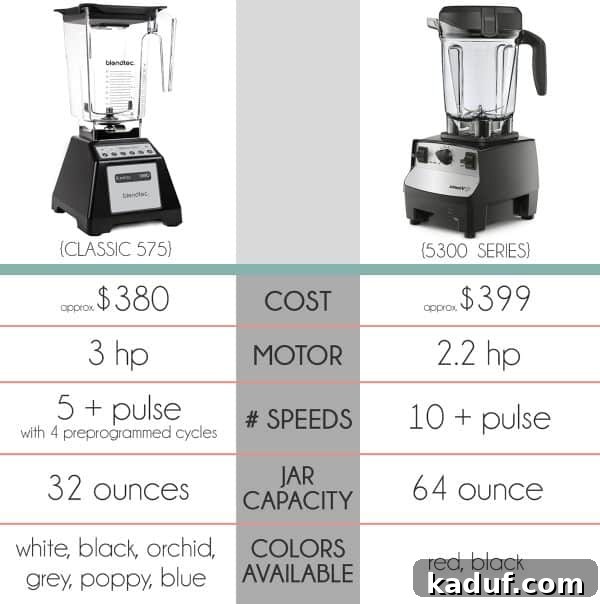
As you can observe, at least for these two specific models, the initial cost is relatively comparable. It’s also worth noting that certified refurbished blenders for both brands are often available at a considerable discount, providing an excellent value proposition for those seeking premium performance without the premium new price tag. However, the price ceiling for these blenders is remarkably high. Both brands offer professional series blenders that can easily exceed $800, boasting advanced features and even more powerful motors designed for commercial-grade usage.
Now, let’s delve deeper into some of the more nuanced pros and cons I’ve personally encountered with each blender during my extensive use.
Performance & Noise: The Heart of the Blend
The core function of any blender is its ability to blend, and in the high-performance category, this translates to power and efficiency. From the general specifications, the horsepower ratings of both blenders appear quite similar. However, it’s crucial to remember that the “peak power” listed for most appliances, including blenders, represents the maximum power output achievable only under very specific, often momentary, conditions. Blenders typically don’t operate at this highest level for extended periods, making peak power a somewhat misleading metric. Annoying but true.
Operationally, both the Blendtec Classic 575 and Vitamix 5300 models operate consistently around 1,400 to 1,500 watts, translating to roughly 2 horsepower. This means that in terms of raw power, there isn’t a significant, discernible difference that would immediately set one apart from the other on paper.
However, from my direct personal experience, despite the Blendtec’s slightly higher stated horsepower, I have found the Vitamix to be a far more enjoyable and effective blending companion based on its superior blending efficiency and consistency.
Can you achieve a deliciously smooth milkshake or a perfectly blended smoothie with either machine? Absolutely. Both blenders excel at these common tasks, and neither significantly outperforms the other in terms of the final outcome for standard recipes. The key distinction lies in how that perfectly creamy texture is achieved, and with what level of effort.
In my experience, the Vitamix consistently blends more quickly and with greater efficiency than the Blendtec, especially when tackling tougher ingredients or thicker mixtures.
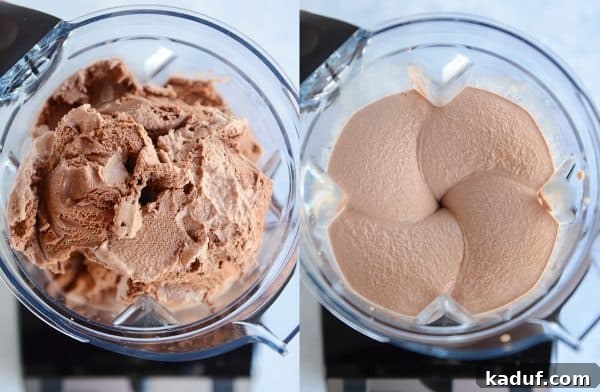
With my Blendtec, I often found myself needing to run the smoothie cycle multiple times, or manually intervene, to achieve the desired silky consistency for our morning smoothies. In contrast, with the Vitamix, I simply turn the variable speed dial to a moderate setting (typically 5 or 6) and let it run for a mere 30-45 seconds, and our smoothies are perfectly blended and ready to enjoy.
I believe this notable difference in blending experience stems from three primary factors: the ingenious design of the jar, the effectiveness of preprogrammed functions (or lack thereof), and the inclusion of the tamper.
While I do have a few minor criticisms regarding the design of the Vitamix jars (more on that below), the low-profile, 64-ounce jar, with its wider and squatter (for lack of a more elegant term) base compared to Blendtec’s jars, undoubtedly earns significant points in terms of blending functionality. The broader surface area at the bottom of the Vitamix jar facilitates better ingredient circulation, especially with larger batches, preventing ingredients from simply spinning in place above the blades. This design, in my very scientific opinion, is a major contributor to its efficiency.
The tamper, an accessory exclusively provided with Vitamix blenders, is often a point of contention among users. Some absolutely adore it, while others find it cumbersome or unnecessary. Personally, I don’t particularly love having an additional piece to clean, but its utility far outweighs this minor inconvenience. The beauty of the tamper is that I don’t need to use it for every blending task. It truly shines when I’m preparing extra-thick mixtures – think incredibly dense frozen fruit smoothies, decadent chocolate milkshakes, or homemade ice cream. In these scenarios, the tamper makes a world of difference, allowing you to push ingredients down into the blades and eliminate air pockets without stopping the machine.
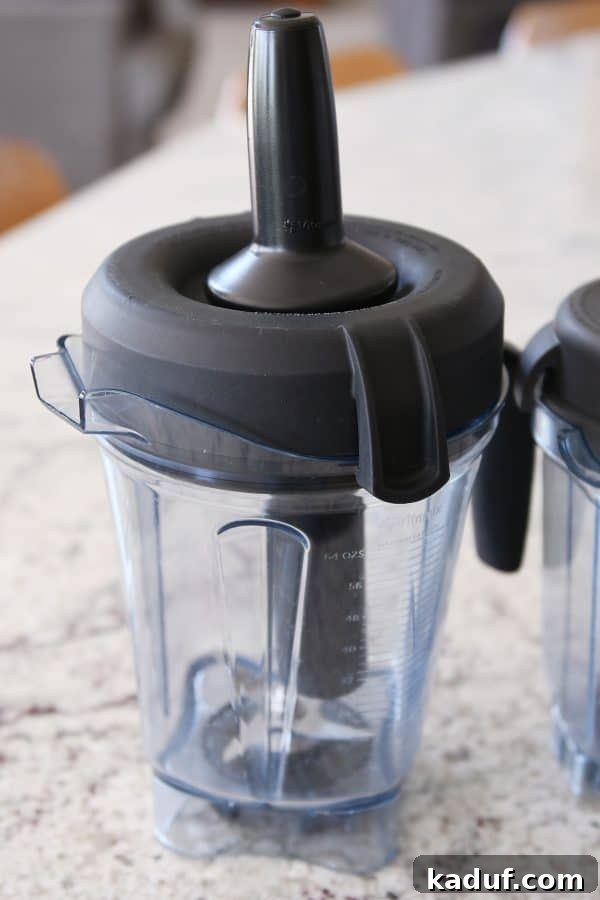
With the Blendtec, when faced with a thick mixture, I frequently had to stop the blender, remove the lid, and manually stir the contents with a spoon or spatula to ensure that the thicker bits at the bottom were adequately drawn into the blades. This interrupts the blending process and can be quite frustrating. The Vitamix tamper, on the other hand, performs this essential task for you while the blender is actively running. Crucially, there’s a safety collar on the tamper that prevents it from ever coming into contact with the spinning blades, ensuring safe operation even at high speeds.
And a quick, undeniable note about noise: let’s be frank – both blenders are inherently loud. There’s simply no escaping it; high-powered motors churning through ice and frozen ingredients will generate substantial noise. While highly scientific tests might reveal marginal differences in decibel levels between the two, in my real-world experience, the difference is not significant enough to be a deciding factor. When these machines are in full swing, your kitchen will be loud!
Options, Ease of Use & Jar Versatility
Beyond raw power, the user experience is heavily influenced by the control options, overall ease of use, and the versatility offered by different jar configurations. As I touched upon earlier, the Blendtec definitely provides a greater array of blending options and preprogrammed cycles.
The specific Blendtec model featured in this post is slightly older than the current Classic series blenders, but the convenience of preprogrammed cycles remains a hallmark of new Blendtec models. These cycles are designed to automatically adjust speed and duration for specific tasks like smoothies, whole juice, batters, or hot soup, offering a “set it and forget it” convenience that many users appreciate.
The Vitamix, by contrast, embodies a philosophy of plain and simple, yet powerful, control. Its interface typically consists of a robust pulse button, a straightforward start/stop switch, and a highly responsive variable speed dial. This minimalist design places the user firmly in control, allowing for precise adjustments to blending speed throughout the cycle, which can be invaluable for achieving very specific textures.
Having used both extensively, I tend to think of the Blendtec as the quick, energetic, “whippersnapper” of the two, rapidly going through its cycles. The Vitamix, meanwhile, feels more like a gentle, rumbling, yet incredibly hardworking giant, capable of sustained power and nuanced control.
And yes, I am aware that describing blenders in such anthropomorphic terms is a bit peculiar.
While I genuinely appreciate the wide, low-profile design of the standard 64-ounce Vitamix jar for its efficient blending of larger quantities, I also recognize that it’s not always the most practical size for smaller families or individuals. Its sheer size can be overwhelming for someone preparing a single serving. For my large family, where I frequently prepare substantial batches of everything from smoothies to soups, it’s absolutely ideal. However, for those who primarily wish to blend smaller amounts of salad dressings, sauces, or single-serve shakes, the low-profile jar can be less effective, as ingredients may not circulate properly and can get caught above the blades.
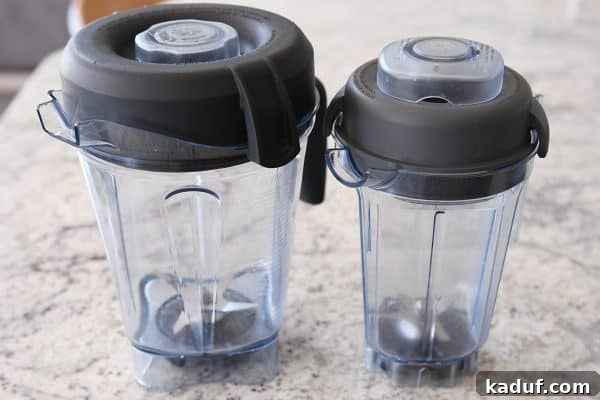
A significant advantage often associated with Blendtec is that many of their blender packages come bundled with two different jars: typically the classic FourSide jar (32 ounces) and the WildSide+ jar (36 ounces). During my time as a Blendtec owner, I also acquired the Twister Jar, which proved invaluable for blending smaller quantities of thicker mixtures such as sauces, salad dressings, and even finely grinding graham cracker crumbs. I truly loved that versatile little jar and its specialized functionality.
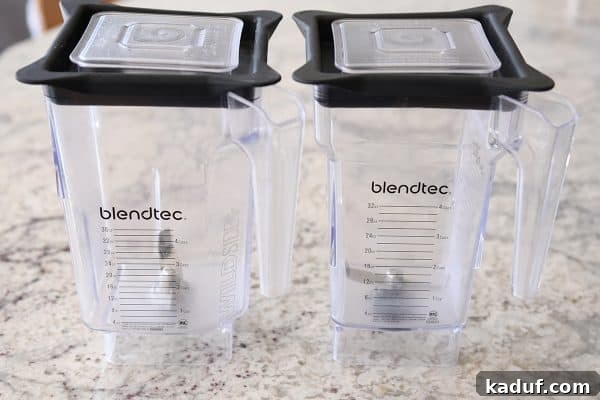
When I initially purchased my Vitamix, it came exclusively with the wider 64-ounce container. Given that I frequently use my blender for multiple tasks in quick succession, and often require different batch sizes, I later opted to purchase the 32-ounce wet container. For my household, having both jars has proven to be well worth the additional expense, significantly enhancing the versatility of my Vitamix. It’s a feature I genuinely wish Vitamix would integrate into their standard blender packages, as it offers immense practical benefit to a broader range of users.
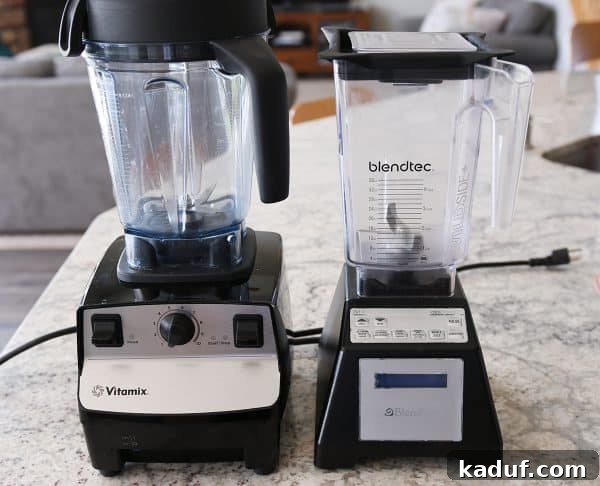
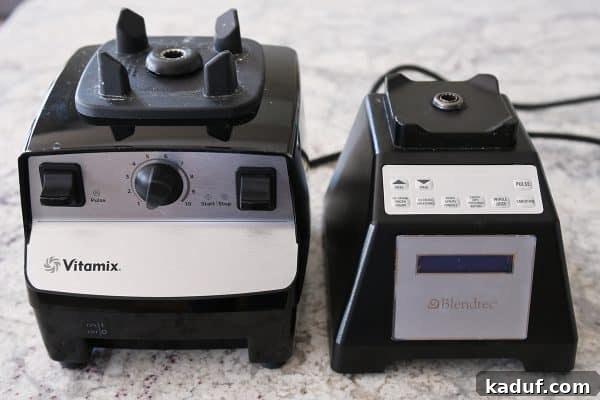
One crucial physical difference to note in this section is that the Vitamix is undeniably heavier, larger, and bulkier than the Blendtec. This difference is immediately apparent from the comparison pictures. The Vitamix base is noticeably taller and wider. As someone who stores both the blender base and its accompanying jars in a kitchen cupboard, I’ve found that the Vitamix setup demands significantly more cupboard space compared to my previous Blendtec setup, a factor that is important for those with limited kitchen storage.
Cleaning & Maintenance
When it comes to the less glamorous, but equally important, task of cleaning, my experience indicates that both blenders are fairly similar in their ease of maintenance. My mother, for instance, is a firm believer in the self-cleaning method: simply add warm water and a drop or two of dish soap to the blender jar, then pulse or run it on a medium speed for 30-60 seconds before rinsing thoroughly. This method is incredibly effective and quick. However, I must confess that I rarely use it, primarily because I’ve usually already returned the blender base to its cupboard by the time I think of it.
Consequently, I typically resort to the good old-fashioned hand-washing method, which works perfectly fine. Honestly, it takes less than a minute to thoroughly clean either a Blendtec or a Vitamix jar by hand. The configurations of the jars and lids, in my opinion, don’t present a significant difference in terms of cleaning effort or difficulty. Both are designed to be relatively straightforward to clean.
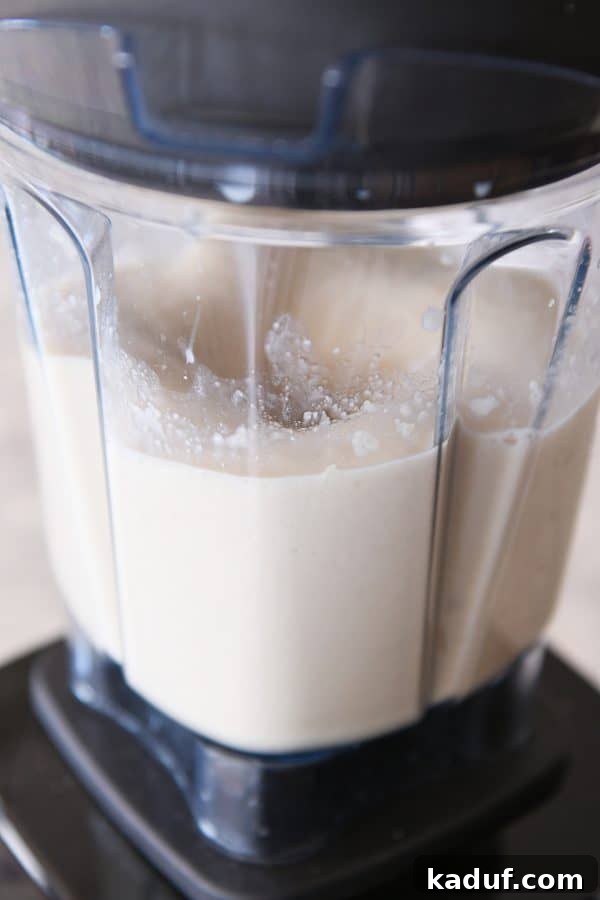
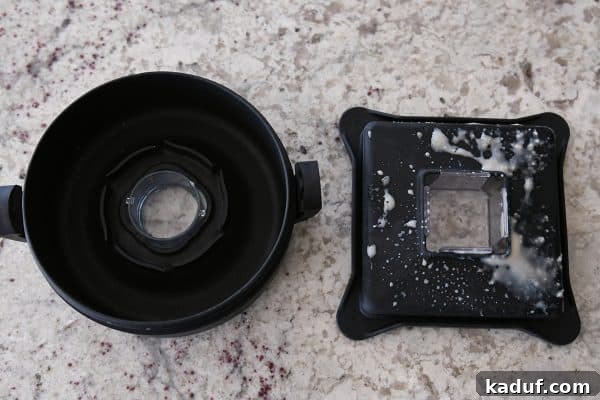
However, I will highlight one distinct difference: I have consistently found that the Blendtec tends to splash around much, much more during blending. The Vitamix, conversely, seems to be considerably less… well… energetic in its operation (refer back to my “gentle giant” analogy). This difference in turbulence can impact the cleanliness of your blender base and surrounding countertop.
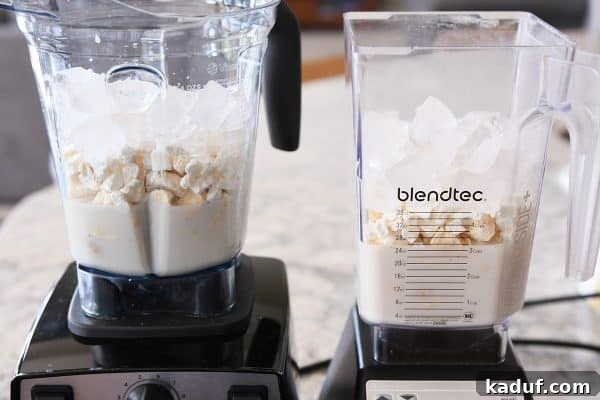
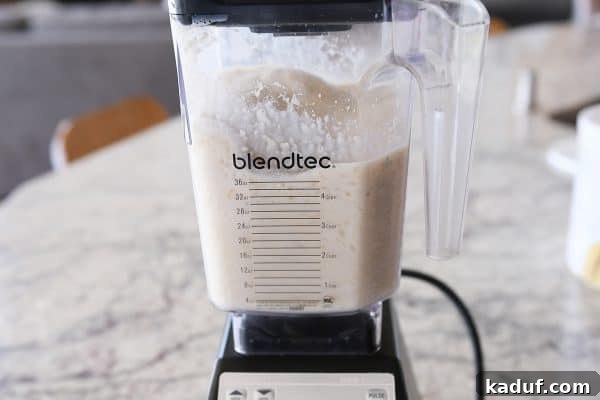
To illustrate this point, consider the state of the lids after blending identical batches of smoothies. While some of this undoubtedly comes down to the specific size and configuration of the respective jars, it still provides a helpful visual representation of the difference in mess potential.
Durability & Longevity
While both Blendtec and Vitamix blenders undoubtedly possess numerous merits (along with their respective minor drawbacks), one area where I can offer specific, firsthand personal experience is in long-term durability. Over the approximately 6-7 years I owned various Blendtec models, the motor burned out on two separate occasions.
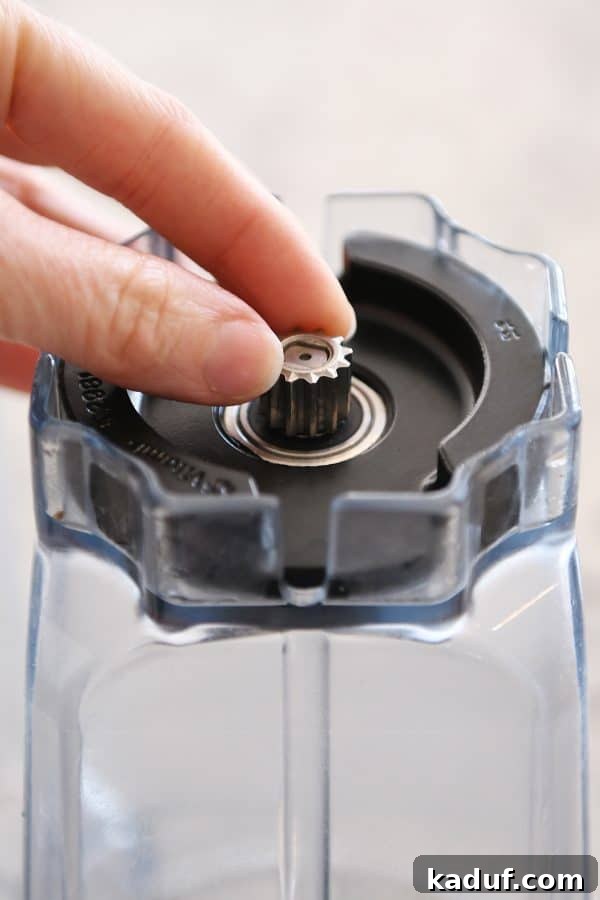
This occurred under what I would consider fairly average daily usage. I consistently adhere to best practices: I never store liquids or food in my blender jars (regardless of brand) overnight, I rarely attempt to make ice cream or other ultra-thick, exceptionally strenuous concoctions (milkshakes are a different story, and well within their capabilities), and crucially, I always make it a habit to manually twist the bottom of the driveshaft that spins the blades before each use. This last tip is something I learned from a knowledgeable Costco salesman many years ago, and I believe it’s a small but significant preventative measure.
UPDATE: Several readers in the comments have inquired for more details about this driveshaft tip, so I’ve included a quick picture to clarify what I mean. Essentially, when I retrieve the jar from the cupboard, I gently give the metal driveshaft extending from the bottom of the blender a small twist. You might notice a slight resistance or stickiness as you twist it – and that’s precisely why this pre-twist is important before you begin blending. As the “blender professional” (as I lovingly called him) explained to me, manually pre-twisting it with your fingers helps ensure the driveshaft and blades are moving freely and don’t stick upon startup, which in turn helps maintain them in optimal spinning condition and reduces potential strain on the motor. It’s a simple, almost unconscious step that has become a deeply ingrained habit for me.
Blendtec consistently honored their warranty, providing refurbished replacement units (though I did, on one or two occasions, encounter some rather frustrating and somewhat “sketchy” experiences with their customer service hotline). However, after my last Blendtec replacement began exhibiting persistent display issues and, more alarmingly, emitted a burning smell while preparing our morning smoothies, I decided it was time to move on from Blendtec and explore the Vitamix alternative.
I’ve only been a Vitamix owner for a little over a year, so it would be premature for me to definitively claim that it is inherently more durable than a Blendtec based solely on my short-term ownership. However, I can report that I have experienced zero issues with my Vitamix thus far, which is a significant positive. Furthermore, my father has owned a Vitamix for several years, also without encountering any problems, lending further confidence in its robust construction. Conversely, I also have many friends who have owned Blendtec blenders for numerous years without any issues whatsoever, demonstrating that individual experiences can vary widely.
Nevertheless, based on my personal track record, my Blendtec blenders did not prove to be as durable or long-lasting as I had initially hoped and anticipated, which was a primary motivator for my switch.
In Summary: Which Blender Is Best?
Well, if you’ve bravely navigated through all this detailed information (and for that, I commend you!), you might still be pondering the ultimate question: which high-powered blender truly is the best choice?
The honest truth is that the “best” blender will inevitably come down to a confluence of personal factors and priorities: your budget constraints, the specific model you’re considering, the size of your family (which directly impacts optimal jar size), available kitchen space for storage (remember, Vitamix generally has a larger footprint), your preference for preprogrammed settings versus manual control, and your typical blending needs. There’s no universal “one size fits all” answer.
However, for me, after extensively using a Blendtec blender for over six years and now having accumulated more than a year of experience with a Vitamix blender, I can confidently and easily state that the Vitamix emerges as the clear winner for my needs.
It consistently blends ingredients better and more efficiently, its intuitive manual controls make it easier to use for precise results, I absolutely love the included tamper which significantly aids in quicker and more thorough blending of thick mixtures, and even though the technical specifications might not always reflect it, the Vitamix genuinely feels much more robust and powerful in its operation compared to the Blendtec blenders I’ve owned.
Overall, based on my extensive personal experience, the Vitamix is the high-powered blender I would wholeheartedly recommend. Nevertheless, I fully acknowledge that its specific features and larger size may not make it the perfect blender for every individual or every kitchen.
And because I’m certain many of you also hold strong opinions on this highly debated topic, please share your thoughts in the comments below! Let me know if you own a high-powered blender, which brand and model it is, and what makes you absolutely love (or perhaps even hate) it! Your real-world experiences are invaluable to others making this important kitchen investment.
Disclaimer: I am a participant in the Amazon Services LLC Associates Program, an affiliate advertising program designed to provide a means for me to earn fees by linking to Amazon.com and affiliated sites. As an Amazon Associate, I earn from qualifying purchases, which helps support the content I create.